The Robert W. Van Houten Library, NJIT’s university library, houses a core collection of print books, group study rooms and has an Information Commons computer lab with more than 120 computer workstations and wireless access throughout the building. The Barbara and Leonard Littman Architecture, Art and Design Library, a branch of the university library, maintains a core collection of architecture, art and design resources. The University Library has a staff of 24, who are committed to developing innovations in access services, information literacy and digital initiatives. The collection comprises over 390,000 volumes with 34 full-text databases, over 55,000 electronic journals, 168,000 ebooks and 222,000 physical holdings.
The Van Houten Library, located in the Central Avenue Building, is about 56,266 square feet and has approximately 600 seats, provides a facility for individual and group study, research, computing, and browsing with wireless access available throughout the building.
Access
The resources of the Van Houten Library at the NJIT primarily support the instructional and research needs of the NJIT community. The library is open to the public for research relating to the NJIT Library's unique science and technology collection. Individuals not affiliated with NJIT may be required to show an acceptable identification card. All library users must comply with NJIT library policies.
More about our mission and vision
Have you ever wondered how library books are assigned their places on the shelves? Did you know that the call number -- the number placed on the spine of the book -- is a code which provides valuable information about the book?
This page will provide an introduction to understanding and using library call numbers.
What are call numbers for?
Each book in the library has a unique call number. A call number is like an address: it tells us where the book is located in the library.
Call numbers appear on the spine or front of the book.
![[call number icon]](/sites/library/files/lcms/images/callno1.gif) |
Note that the same call number can be written from top-to-bottom, or left-to-right.
The NJIT libraries, like many college and university libraries in the north America, uses Library of Congress Classification for call numbers. This system uses a combination of letters and numbers to arrange materials by subjects.
Reading call numbers
![[call number 2 icon]](/sites/library/files/lcms/images/callno2.gif) |
To Re-emphasize:LB 2395 is "LB two thousand, three hundred, and ninety five" .C65 is "point C six five" |
Putting call numbers in shelf order
To understand how call numbers are put in order in Library of Congress Classification, again look at each section of the call number.
![[call number 3 icon]](/sites/library/files/lcms/images/callno3.gif) |
What does the call number mean?
Remember that Library of Congress Classification arranges materials by subjects. The first sections of the call number represent the subject of the book. The letter-and-decimal section of the call number often represents the author's last name. And, as you recall, the last section of a call number is often the date of publication.
Example:
![[call number 4 icon]](/sites/library/files/lcms/images/callno4.gif) |
Why is this important to know?
Because books are classified by subject, you can often find several helpful books on the same shelf, or nearby. For example, within the same call number LB2395, there are other guides for college study.
![call number 5 icon]](/sites/library/files/lcms/images/callno5.gif) |
Since Library of Congress Classification arranges materials by subjects, knowing the letter(s) for your subject area gives you a place to start browsing the shelves. Which letters represent your subject? View the Library of Congress Classification table.
Location prefixes
When you find a book in our Voyager online catalog, the call number will be preceded by a location prefix.
-
Example:
- Stacks (lower level) AG243 .G87 1992
- The Stacks (lower level) prefix indicates that this book is shelved in the books stacks in the bottom (basement) level of the library.
Location prefixes mean that book is shelved in a special place, and may have loan restrictions. Here are some of the NJIT location prefixes:
- Stacks (lower level)
- Circulation Desk (usually Reserve material)
- Disk (ask at the Circulation Desk)
- Reference stacks (main floor, southeast corner)
- ArchLib stacks (aisles 2 through 9)
- Temporarily Shelved at Arch Desk
Points of learning:
|
This web page adapted by the NJIT library from one done by the Honolulu Community College.
Information Literacy & the Library Website
Maya Gervits and Jessica Fadel worked on the redesign of the Architecture Library page. Bruce Slutsky, Haymwantee Sighn, Davida Scharf, and Heather Huey worked on the Research Helpdesk pages for the main library website. The requirement to move all content from one webserver to another was a time-consuming task but critical to information literacy in the fall, so it took an unwished for priority. Training was delayed, but all necessary content was eventually moved with some minor improvements as possible. All the librarians learned and used Site Studio to recode, update, restructure research help desk pages to better fit the needs of our students and guide library instruction. New pages were added; old out of date pages were updated or taken down. Bruce, using information from his Google analytics study, cleaned out the subject guides and revamped the remaining ones. Heather worked with other librarians to craft and then coded a set of 17 FAQs in Site Studio for the first time for the library website.
Information Literacy at the School of Architecture
Maya Gervits participated in a team of librarians who developed Information Competencies for Students in Design Disciplines.
Intelliresponse
Haymwantee Singh has been learning the new Intelliresponse software system being used at NJIT. With the rest of the library staff, she will input the required 85 questions to start this on online database of FAQs.
Fall Semester Instruction Preparation
The summer is the time for scheduling, organizing and planning for the busy fall semester.
Bruce Slutsky, Haymwantee Singh and Davida Scharf focused on info literacy planning with Interim Dean, John Schuring and Prof. Ron Rockland at NCE in order to create an IL implementation plan that works within the NCE curriculum. Meetings were postponed several times due to ABET planning. They met once with the new Dean during the summer who agreed with the planning that had preceded. (See the Strategic Plan for more details). This consumed much of the summer for Engineering librarians.
All librarians were active in seeking to increase collaborations with professors to prepare and schedule upcoming instructional sessions. Since our goal is to integrate closely with the existing syllabus, session preparation and collaboration though time consuming received a high priority.
Information Literacy Assessment
All librarians frequently develop and use formative assessment tools—usually exercise during or following class that put the knowledge to work in some way. The in-class exercises for architecture studio sessions and Freshman Composition classes are collected and graded by the librarians. This way, we can assess what the students were not able to understand in the session to improve information literacy instruction and to share with professors which students need more instruction. This mostly addresses ACRL standards #2 and #5. Heather Huey designed an information literacy assessment experiment to test in the fall semester in HUM 101.
Approximately 80 graduating CS majors took the iSkills test and scored somewhat higher overall than students in previous studies. ETS iSkills data from Spring 2007 was analyzed, then ETS notified us that there had been errors in the online reports, so this must still be re-analyzed.
The ETS/NJIT collaborative study team (including Davida and Heather) is still working on the draft of the study which must still go for internal peer-review at ETS.
Davida also participated in monthly conference call meetings as a member of the ETS National Advisory Board to the iSkills test. The annual meeting is scheduled for October, at the University of Central Florida.
ACRL-NJ User Education Committee
As part of the ACRL-NJ User Education Committee we began a study to assess the ICT skills and thoughts of New Jersey Academic Librarians using the ETS iSkills test. We hosted the June meeting that included a session at NJIT at which ACRL-NJ librarians could take the test and then discuss it. Only 5 librarians took the scored version of the test, so the sample was too small to be statistically meaningful. However the discussion that followed seemed to be helpful to those who attended and NJIT did advance knowledge of the test in the NJ community.
WebCT Training
The librarians turned backup support routines for WebCT. Not only will this help when Blake Haggerty is out on leave, but this training has increased our knowledge to better help students at the research help desk.
Library Video for Freshmen
Davida scripted the library video, working with Joseph Rios and staff to execute. This video is on NJIT iTunes University and the library’s homepage. This is required viewing for all First Year Seminar Courses. The students have to complete an assignment to answer questions explained in the video.
Endnote
Reference and other librarians received introductory training and a handout prepared by Davida on Endnote with instructions that have also been posted on the website
Miniversity
Heather Huey gave tours and a brief introduction to the library to all miniversity sessions in June and July.
MySpace & Facebook
Heather Huey presented on the use of myspace & facebook at Rutgers. She continues to research ways to use this tool for information literacy, yet currently finds it is most effective for marketing library resources and appearing more approachable to answer reference questions.
Newark Area Library Catalogs
- Rutgers University Libraries catalog
- Rutgers University Library: Health Sciences catalog
- Newark Public Library catalog
- Essex County College Library catalog
Northeast New Jersey Library Catalogs
- Fairleigh Dickinson University Library Catalog
- Montclair State University Library Catalog
- Kean University Library Catalog
- New Jersey City University Library Catalog
- William Paterson University Library Catalog
New York City Library Catalogs
- Columbia University Libraries Catalog
- New York Public Library
- City University of New York Libraries Catalog
- Polytechnic University, Brooklyn Catalog
New Jersey Libraries
- Links to New Jersey Colleges and University Library Systems - compiled by the State Library
OCLC WorldCat.org
WorldCat.org links you to 2 billion items (books, videos, journals, and more) available through 10,000 libraries worldwide.
Google Book Search
The library does not usually purchase videotapes and DVD's because such material are generally intended for classroom use or viewing as part of course assignments. Videotapes and DVD's to be used in that way-as teaching materials and instructional aids-are the financial responsibility of the academic departments.
On occasion when the library purchases videotapes or DVD's from its own materials budget, the decision to purchase such material on a given topic is made the by librarian with liaison responsibility to the appropriate department. Some rules of thumb guide the librarians in their decision:
- Would the library normally purchase material on the subject?
- Is the subject appropriate for the medium of the moving image? Or would a book on the subject be more appropriate?
- Does the videotape or DVD cost near the amount that a book would cost on a similar treatment of the same subject?
- Is the videotape or DVD more likely to be used as teaching material or an instructional aid or is the videotape more likely to be of interest to general library users seeking information on that subject?
Videotapes and DVD's which the library purchases from its own materials budget are not scheduled for users so that they are available at a given day or time for guaranteed use. The library has no automated or manual mechanism for scheduling materials for viewing or borrowing. In addition, if the library scheduled videotapes and DVD's, it would be supporting their public exhibition, which would, in most cases, violate copyright laws and videotape and DVD purchase agreements.
The library does have a small circulating collection of entertainment videotapes (e.g., feature films) that have been donated to the library. The library will accept additional donations of such videotapes, as well as DVD's, subject to review by the library for appropriateness and copyright compliance. These, too, are not scheduled.
The library will store and circulate videotapes and DVD's purchased by academic departments for use as teaching materials and instructional aids, but it will not schedule them unless a prior separate mutually signed agreement between the library and the department has been worked out. In those cases, insuring the usage agreement is in compliance with copyright law is the responsibility of the department purchasing the material.
Adopted at the Dec 14, 2001 Librarians Meeting
Subscription-based access to Building Green Suite is only available to Maya Gervits, Director of the Littman Architecture Library.
Please contact her for further research assistance.
Phone (973) 596-4390
Click to go to Building Green Suite

Chat with a librarian
Connect to our 24/7 real-time, online question service. This service is staffed by UW Librarians, but at peak service times or off-hours you may be chatting with a librarian from another academic library.
Click to chat with a Librarian

Consultations
Schedule a one-on-one session with a Subject Librarian, Writing and Research staff, or other experts who offer help using data visualization tools, digital media tools, managing data, and more.

Fill out the question/comment form and receive a response via email.
| Mailing address | Street address for driving directions |
|---|---|
| Robert W. Van Houten Library New Jersey Institute of Technology 323 MLK Jr. Blvd / University Heights Newark, NJ 07102-1982 |
Robert W. Van Houten Library New Jersey Institute of Technology 186 Central Ave. Newark, NJ 07103 |
Contact Numbers
| Area | Extension |
|---|---|
| Van Houten Library (automated menu system) | 973-596-3206 |
| Van Houten Research Help | 973-596-3210 |
| Van Houten Library Circulation & Reserves Desk | 973-596-6371 |
| Van Houten Library Interlibrary Loan / Document Delivery Office -- voice | 973-596-3204 |
| Van Houten Library Interlibrary Loan / Document Delivery Office -- fax | 973-642-7862 |
| Van Houten Library Thesis and Dissertation Office | 973-642-4386 |
| Van Houten Fax Number (admin office) | 973-642-7166 |
| Van Houten Library Conference Room -- (Faculty Commons, room 2032) | 973-642-4567 |
| Van Houten Library Mailroom | 973-596-2334 |
| Littman Library -- Reference Desk | 973-642-4390 |
| Littman Library -- Circulation Desk | 973-596-3083 |
| View Staff Directory | |
| Driving Directions | Mailing Address |
|---|---|
| Robert W. Van Houten Library New Jersey Institute of Technology 186 Central Avenue Newark, NJ 07102 |
Robert W. Van Houten Library New Jersey Institute of Technology University Heights Newark, NJ 07102-1982 |
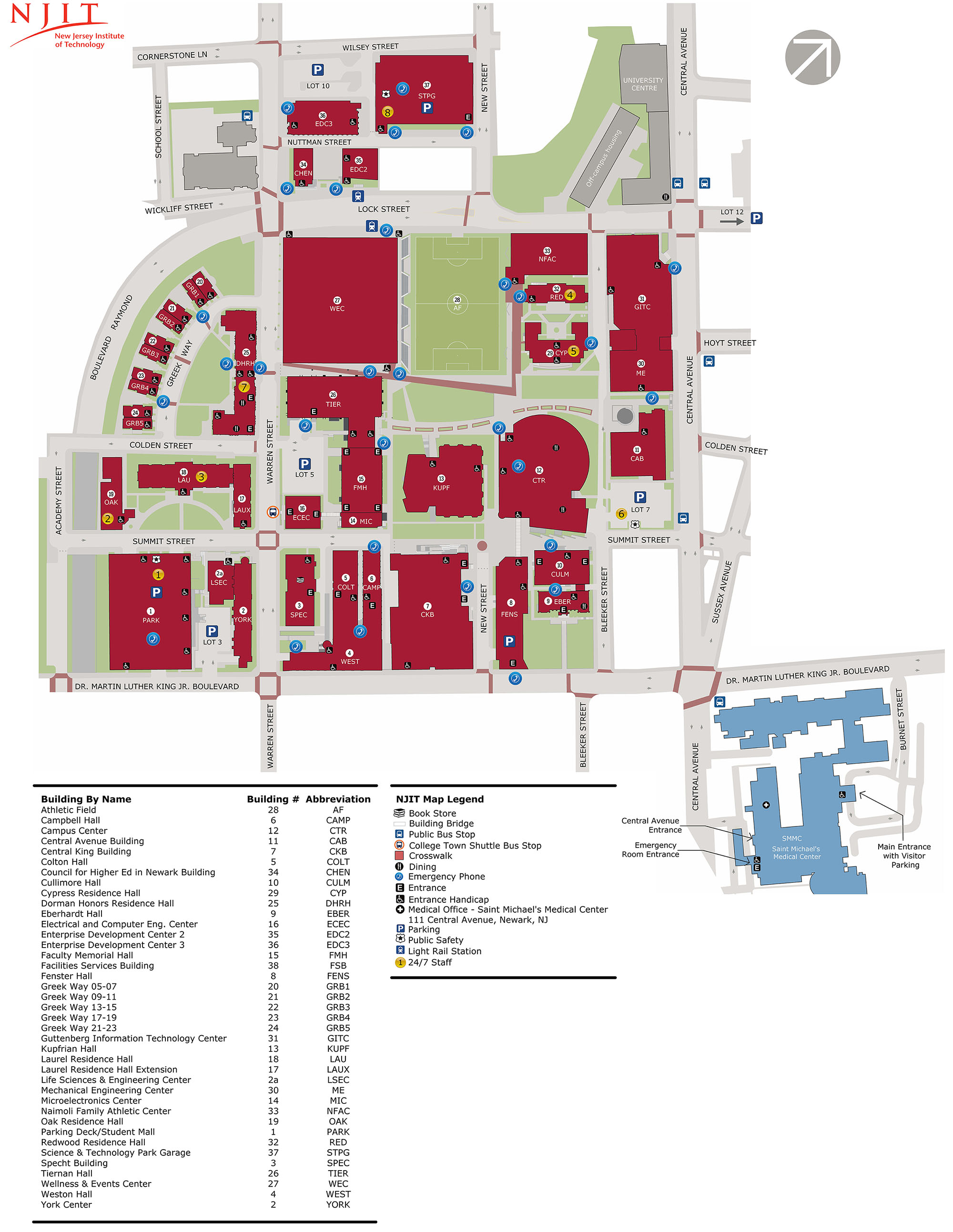
- The Van Houten Library is located in the Central Avenue Building
- The Littman Library is located in the Weston Hall Building
Direction to NJIT Campus
- Directions: Getting to Campus
- Campus Map
- Campus Parking Map (high resolution) - parking Map: All university parking lots are designated for specific types of usage during normal hours (e.g. student, faculty/staff, visitor, reserved parking). More about parking.
Information Literacy Accreditation Standards
Middle States Commission on Higher Education
- Characteristics of excellence in higher education
The standards for accreditation require information literacy embedded and assessed in the higher education curriculum. - Developing research & communication skills: guidelines for information literacy in the curriculum
Middle States Adopted the ACRL Standards
- Information literacy competency standards for higher education (ACRL, 2000) A "framework for assessing the information literate individual," and an outline of the process by which "faculty, librarians and others can pinpoint specific indicators that identify a student as information literate."
- Objectives for information literacy instruction: a model statement for academic librarians (ACRL, 2001) Includes information about the development of the objectives.
Based on the ACRL Information Literacy Competency Standards for Higher Education, "each performance indicator is accompanied by one or more outcomes for assessing the progress toward information literacy of students of science and engineering or technology at all levels of higher education."
Newark College of Engineering
- Accreditation Board for Engineering and Technology (ABET) Lifelong Learning
-
For Computing Programs
Criterion 3 – Program Outcomes. (i) a recognition of the need for, and an ability to engage in life-long learning -
For Engineering Programs
Criterion 3 – Program Outcomes. (i) a recognition of the need for, and an ability to engage in life-long learning -
For Engineering Technology Programs
Criterion 3 – Program Outcomes. (i) a recognition of the need for, and an ability to engage in life-long learning
-
College of Architecture and Design
- National Architectural Accrediting Board (NAAB) Conditions for Accreditation.
- National Association Of Schools Of Art And Design (NASAD) Handbook.
See Page 43 - Council for Interior Design Accreditation Manual
School of Management